
Madrid Is a Machine for Making You Lonely — Unless You Know Where the Door Is
If you just moved to Madrid and the city feels warm but impossible to get inside of, this is for you. A year of PrideChueca, told for the person who arrived alone.
PrideChueca is, at its heart, a village square inside a huge city — a place in Madrid’s Chueca neighbourhood where you can show up and simply be seen. It began as a very active LGBTQ+ community and it has become something more specific: an answer to the particular loneliness of a city where everything keeps moving except the people you decide to keep.
There’s a saying expats pass around about Spain: a Spaniard will invite you to his home, but never quite give you the address. It’s an exaggeration, but everyone who has moved here recognises the truth underneath it. Madrid is one of the warmest, most welcoming cities in Europe — and also one where social circles can feel sealed. You’re either in, or you’re out, and from the outside it’s hard to see how anyone gets in at all.
So this is the honest version, written for the person the guidebooks skip: the one who landed with excitement, watched the loneliness quietly deepen week after week, and started to wonder whether moving here was a mistake at all. If that’s you, you’re not doing anything wrong. You’ve just run into the real shape of a big city.
The real problem with Madrid: everything is liquid
Madrid has a thousand virtues, but one of its deep problems is how liquid it is. Nothing stays still. You find a flat, and then the rent rises and pushes you out. Your flatmates change. You finally save enough and move somewhere else, and that corner café where they’d started to recognise you disappears from your life. A new neighbourhood, and once again you’re a stranger somewhere else.
And it isn’t only newcomers who feel it. Even people who’ve lived here for years watch it happen: the neighbours move away, a bar closes because it can’t pay the rent, another closes because the owner realised a holiday rental pays more. Don’t misunderstand us — we love that travellers come. We wouldn’t have an international side to the community if we didn’t, because not everyone who arrives is here to stay, and welcoming the person who just landed is part of who we are.
The problem isn’t any one of those things. It’s all of them at once. Added together they create an enormous liquidity: a life where everything slips through your fingers, and little by little you lose your connection to the life of the city itself — without even noticing it happen.
Why the community outlives the geography
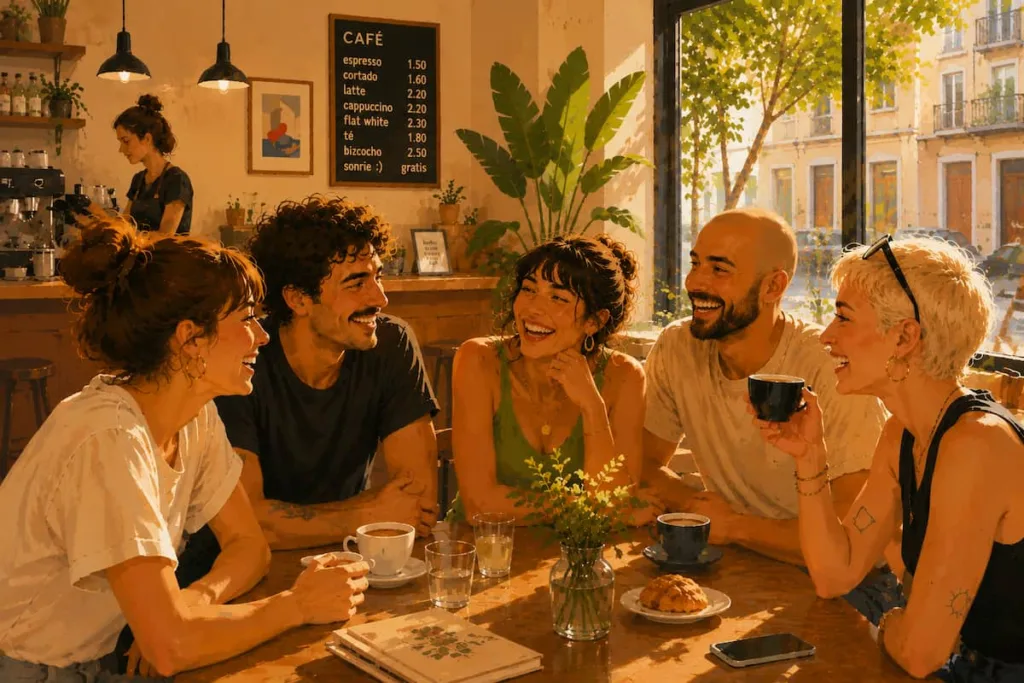
This is the whole point. However much the map changes, the group stays alive, connecting people the way it always has. Because even when you move, you know there’s a square you can drift into. Someone writes “anyone up for a coffee?” and a place to meet appears. The geography has broken, but the connections are more alive than ever. If the board-game bar closes, we go to another one. That simple. And — if this had never existed — that impossible.
Because Madrid is a beautiful city, but like every big city, it’s a machine for generating loneliness if you’re not paying attention. Everything moves fast, and in modern life it’s easy to retreat into a screen of one kind or another. That’s where it starts: you drift a little, you fill a few hours on your favourite screen, and by the time you notice, those hours have grown. And every hour there is one less chance to reconnect — with the city, with the place, with people. Loneliness doesn’t arrive all at once. It arrives by accumulation, without warning.
We built a space for the women, too
At the start we had a very active gay community, and at some point we noticed something: there were few spaces for women. So we gave that part shape too. And we didn’t do it alone. Some wonderful people stepped up to help run the whole women’s side — coordinating, caring for it, keeping the harmony. Without them, honestly, none of this vitality would have held together. We say it plainly because it’s true: some things only happen when someone decides to put their time and their heart into making them happen.
And there were beautiful nights. Men-only meetups. Lesbian-only meetups. Parties. Board-game nights. Mixed gatherings of everyone together. Slowly, watching it work, we realised we were on the right track — that people can change neighbourhoods, but that we are the square where your people always are.
The city moves. Bars open and close. Rents rise and people relocate. But the square isn’t a spot on the map — it’s the people who form it. That’s why it can change address a thousand times and still be, always, the same place.
That’s what PrideChueca is. Not a venue, not an address, not a sign over a door. A community that acts as emotional infrastructure in a city built to scatter you. A place to come back to when everything else has moved. If you’ve just arrived in Madrid, if the neighbourhood isn’t what it used to be, if you’ve spent one too many evenings in a row staring at a screen — this exists, and it’s for exactly that. The door isn’t hidden. You just had to know it was here.